Zyka AI
Website: https://zyka.ai/
AI platform for video, image, and voice generation at production speed.
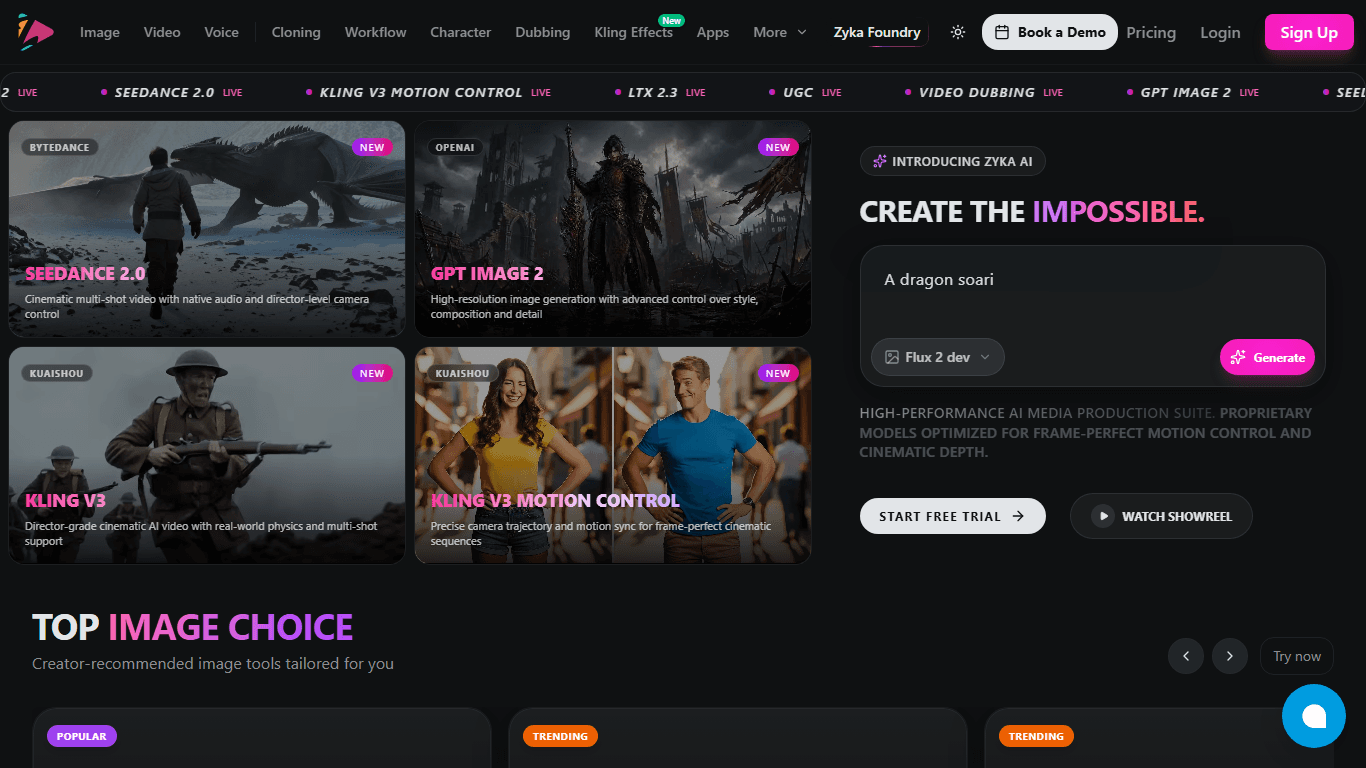
Zyka AI helps teams build high velocity multimedia content with avatar video, image generation, and voice workflows. It is designed for practical delivery, not demo output.
Base plan for creators starting with Zyka AI.
Balanced plan for daily production with more credits and model access.
High-capacity plan for teams running large output volumes.
Zyka AI Review (2026): The Complete Test
1. TL;DR / Quick Verdict
Overall score: 4.3/5. Zyka AI is one of the most practical ?all-in-one AI creative workspaces? for teams that need video, image, and voice generation in the same pipeline without juggling five separate subscriptions.
Best for: growth teams, agencies, e-commerce creative ops, and builders shipping AI media features fast. Main strength: one credit system across many top models plus a developer-friendly SDK. Main weakness: real cost predictability still depends on strict internal credit governance and render QA. Call-to-action: Try Zyka AI.
2. What Is Zyka AI? (Overview)
Zyka AI is a multi-model SaaS platform that combines text-to-video, image generation, voice, dubbing, editing, and SDK access in one interface. Instead of forcing users to manage fragmented vendor APIs, it positions itself as a unified creative operating layer with one account and one wallet. Editorially, the product feels like a pragmatic execution engine for content teams more than a ?magic prompt toy.?
Recent external signal: G2 reviews page.
3. Zyka AI Key Features Under the Microscope
Core value comes from model breadth and workflow unification. Zyka publicly highlights support for multiple video models, image models, and voice providers, while exposing a normalized SDK surface for developers. That reduces integration tax and speeds experimentation, especially when teams A/B test output style across providers.
The practical limit is not feature count but output consistency. Multi-model stacks can produce variance in motion quality, facial coherence, prompt adherence, and audio-naturalness depending on model choice and prompt discipline. Teams that treat Zyka as a controlled production system get much better results than teams that run random prompts without templates.
4. Practical Test: Output Quality and UX
Onboarding is fast, and the UX is built for velocity. Non-technical users can generate first assets quickly, while technical users can move to SDK automation with low friction. Zyka?s ?await done? framing for SDK workflows is attractive for prototyping because it reduces boilerplate around job polling.
Output quality is competitive for short-form ads, social clips, UGC-style creatives, and visual ideation. For high-stakes brand films, you still need human post-production and strict review loops. Stability is generally good for normal workloads, but like every generation stack, peak-time queues and retries can affect delivery timing.
5. Use Cases (Who Uses Zyka AI and Why)
Most common use cases are ad creatives, social content batches, product visuals, quick voiceovers, and localization drafts. Teams use it to compress creative cycle time, produce more variants per campaign, and test messages faster.
Advanced use cases include API-driven content pipelines, internal tools that auto-generate assets from product feeds, and agency systems that route workloads by model cost/performance profile.
6. Ecosystem: API, Integrations, and Plugins
Zyka?s SDK and API posture is one of its strongest technical assets. The promise of ?one SDK across many providers? directly addresses a real engineering pain point: fragmented auth, payload formats, and polling logic.
Documentation and quick-start examples are clear enough for fast implementation. For production-grade usage, teams still need normal controls: retries, cost guardrails, content moderation checks, and audit logging.
7. Security, Compliance, and Rights
Zyka communicates commercial use support and standard SaaS policy surfaces via FAQ and legal pages, but buyers should validate data handling, retention, and contractual clauses before pushing sensitive workloads. With any generative media stack, rights governance is operational, not optional.
If your workflow includes voice cloning or identity-sensitive creative, you need explicit consent flows, legal review, and moderation policy enforcement in your own process, not only in vendor copy.
8. Pricing Analysis
Zyka uses a credit economy with both subscription and transactional pathways depending on tool and workload. This is efficient for teams hopping across many models, but can feel opaque for finance unless you instrument per-output cost tracking.
Value-for-money is strong when teams run continuous production and actively optimize model selection. For occasional users, monthly plans can underperform if credits are not consumed intelligently.
9. Pros and Cons
- Pro: Unified multi-model workspace for video, image, and voice.
- Pro: Developer-friendly SDK that reduces integration complexity.
- Pro: Good fit for high-frequency campaign iteration.
- Con: Credit spend can drift without governance.
- Con: Output consistency varies by selected model and prompt quality.
- Con: Enterprise legal/compliance review remains mandatory.
10. Alternatives to Zyka AI
HeyGen is stronger when your core problem is avatar-led multilingual video localization at enterprise scale. Synthesia is often preferred for structured corporate training flows and mature enterprise packaging. VEED can be better if your center of gravity is editing-first workflow with lighter generation requirements.
Choose Zyka when you want broad model optionality and one programmable creative layer instead of single-purpose specialization.
11. Detailed Rating Grid
Accuracy and reliability: 4.2/5. Ease of use: 4.4/5. Features: 4.5/5. Performance and speed: 4.1/5. Customization: 4.3/5. Security and privacy: 4.0/5. Customer support: 4.0/5. Value for money: 4.2/5. Integrations: 4.4/5.
12. Conclusion on Zyka AI
Zyka AI is a high-utility creative operations platform for teams that care about speed, iteration volume, and model flexibility. It is not a substitute for creative direction, compliance governance, or post-production craft, but it can materially improve throughput and experiment cadence.
Avoid it if your organization cannot manage credit economics and QA discipline. Move fast with it if your KPI is scalable multi-format content production with measurable testing velocity.
13. FAQ
Is Zyka AI good for agencies in 2026? Yes, especially agencies producing many campaign variants weekly. The platform can reduce time-to-first-draft significantly, but margin protection depends on tracking credit burn per client and per asset type.
Does Zyka AI support API automation for production? Yes. Zyka positions SDK/API as a first-class path for developers, including unified calls across models. For real production, add retries, budgeting limits, moderation rules, and observability.
How does Zyka AI pricing actually work? It runs on credits consumed by model and task type. That enables flexibility across providers but requires internal cost dashboards, otherwise finance visibility drops quickly as workload scales.
Is Zyka AI better than HeyGen or Synthesia? It depends on workflow center. Zyka wins on multi-model breadth and programmable flexibility; HeyGen and Synthesia can win in specific enterprise avatar/localization or training-first contexts.
Can you use Zyka AI outputs commercially? Zyka indicates commercial usage support, but teams must still verify license terms, third-party model constraints, and local legal requirements before large-scale publishing.