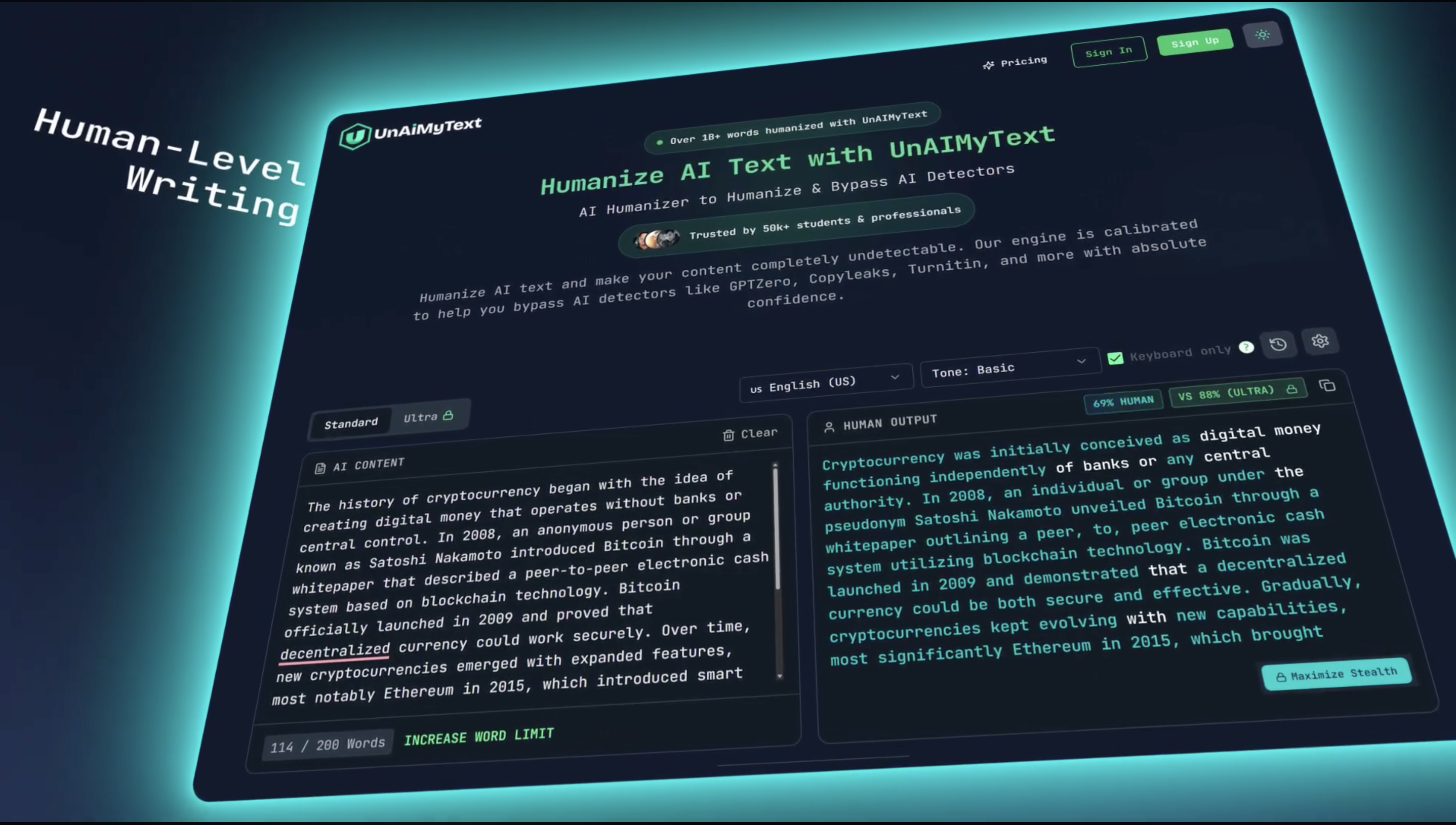
Detailed pricing plans are not available yet for this tool.
Manage Cookie Consent To provide the best experiences, we use technologies like cookies to store and/or access device information. Consenting to these technologies will allow us to process data such as browsing behavior or unique IDs on this site. Not consenting or withdrawing consent, may adversely affect certain features and functions. Functional Functional Always active The technical storage or access is strictly necessary for the legitimate purpose of enabling the use of a specific service explicitly requested by the subscriber or user, or for the sole purpose of carrying out the transmission of a communication over an electronic communications network. Preferences Preferences The technical storage or access is necessary for the legitimate purpose of storing preferences that are not requested by the subscriber or user. Statistics Statistics The technical storage or access that is used exclusively for statistical purposes. The technical storage or access that is used exclusively for anonymous statistical purposes. Without a subpoena, voluntary compliance on the part of your Internet Service Provider, or additional records from a third party, information stored or retrieved for this purpose alone cannot usually be used to identify you. Marketing Marketing The technical storage or access is required to create user profiles to send advertising, or to track the user on a website or across several websites for similar marketing purposes. Manage options Manage services Manage {vendor_count} vendors Read more about these purposes Accept Deny View preferences Save preferences View preferences {title} {title} Skip to content Donate Store Donate Store Economic and Community Resilience through Technology. We use Economic thinking and technology innovation to solve big human challenges, transform institutions, and impact people's lives today. Make a difference! Support our ongoing fundraising campaigns for Ukraine: Donate for Ukraine Donate for Emergency Humanitarian Internet Urgent Donate for Ukraine Help us Provide Critical Defensive Equipment Donate for Ukraine Donate to Empower Ukraine’s Children Impacting People Now. LifeForce UkraineUkraine's largest humanitarian aid matching platform. We provide civilians real-time access to food, shelter, medicine, healthcare, across 37,000+ service locations and 40+ full time staff in-country. EurekaThe world's only integrated intelligent personalized assistant for refugees. Eureka makes it simple for anyone to navigate and power through the complex bureaucracy of integration into a new community. Witness UkraineUkraine's largest war journal platform, recognised by all of Ukraine's regional governments. Giving civilians a platform to safely record and share their stories, to help justice prevail. Economists for UkraineA global collective of economists and academics working to end Russia's invasion and rebuild Ukraine. From the Yermak-McFaul Sanctions group, to the largest academic support program. How we create impact Deploy. We design, deploy, and scale real economic and tech solutions that put people first and solve real problems. Educate. We engage students, business-leaders, economists, technologists, policy-makers, and governments. Govern. We craft cutting-edge technology-driven policy solutions at all-levels of government. See our Work The Pulse Inspirational news, project updates, perspectives and impact stories worth sharing. Welcome to the Pulse. Visit our Blog Trending Data Sets Explore SDG related data sets from across the community with AI for Good's SDG Data Catalog. (GHDx) Global Health Data Exchange A data catalog on global health and demography information created and supported by The Institute for Health Metrics and Evaluation (IHME) at the University of Washington. Datasets by World Research Institute Provides datasets on various issues including flood hazard maps, water risk indicators and water stress projections across the globe. Global Forest Watch Provides data about forests including land cover, land use, biodiversity metrics and forest change allowing for the monitoring and management of forests. Humanitarian Data Exchange A collection of datasets focused on humanitarian issues. NOAA – Climate.gov Provides science and information, focusing on news, data, and climate teaching materials, and the data products and services to track global climate data. Ocean Tracking Network The Ocean Tracking Network is a global aquatic animal tracking, data management, and partnership platform. SDG16 Data Initiative Pulls together data sets in an open format to track SDG16 and provide a snapshot of the current situation, and eventually progress over time. WJP Rule of Law Index Covering major topics on law and order by country. More Data Sets Our Network AI + Sustainable Development Goals Library In this AI+SDG Library, uncover impact opportunities in pursuit of the 17 SDGs, progress of ongoing AI + ML initiatives, and open resources & datasets for you to get involved. » Learn more At current consumption, by 2050 we will need 3 planets to sustain us. Climate related disasters cost 520 billion USD each year. Land based activities cause 80% of marine pollution. 22% of known animal species are facing extinction. Every minute, 20 people are displaced due to conflict or persecution. World Trade is expected to decline by 40% in 2020. 38 percent of Africans live in extreme poverty. 795 million people don’t have access to enough nutrition. 300,000 women die each year from pregnancy complications. Even today, 750 million adults can’t read and write. 7 in 10 women experience physical or sexual violence. 1 in 3 people globally don’t have access to safe drinking water. 600 million people lack access to modern electricity. More than 204 million people remain unemployed. 2.4 billion people lack access to basic sanitation. The richest 1% earn 22% of total global income. Cities account for over 70% of global carbon emissions. At current consumption, by 2050 we will need 3 planets to sustain us. Climate related disasters cost 520 billion USD each year. Land based activities cause 80% of marine pollution. 22% of known animal species are facing extinction. Every minute, 20 people are displaced due to conflict or persecution. World Trade is expected to decline by 40% in 2020. 38 percent of Africans live in extreme poverty. 795 million people don’t have access to enough nutrition. 300,000 women die each year from pregnancy complications. Even today, 750 million adults can’t read and write. 7 in 10 women experience physical or sexual violence. 1 in 3 people globally don’t have access to safe drinking water. Share this Page Get Involved Join our efforts to unlock AI’s potential towards serving humanity. Support us Support new research and collaborative projects to meet the UN’s Sustainable Development Goals. Donate now Become a Partner Collaborate with us on AI and Machine Learning Projects and Policy to make a meaningful impact. Partnerships Volunteer with us Join our team to design, build or guide innovative AI research to shape the future of global policy. Volunteer Newsletter Receive monthly newsletter updates on how AI for Good is creating impact around the world. Subscribe Economic & Community Resilience through Technology Support us By donating to AI4Good.org, you’re investing in a better reality. Donate Subscribe Stay in touch and receive regular updates on our work. Sign up Connect with us Stay up to date and follow us on Social Media. Facebook-f Twitter Instagram Youtube Linkedin © 2026 AI for Good Foundation • an IRS 501(c)3 Public Charity (81-1631000) Manage consent Notifications --- Manage Cookie Consent To provide the best experiences, we use technologies like cookies to store and/or access device information. Consenting to these technologies will allow us to process data such as browsing behavior or unique IDs on this site. Not consenting or withdrawing consent, may adversely affect certain features and functions. Functional Functional Always active The technical storage or access is strictly necessary for the legitimate purpose of enabling the use of a specific service explicitly requested by the subscriber or user, or for the sole purpose of carrying out the transmission of a communication over an electronic communications network. Preferences Preferences The technical storage or access is necessary for the legitimate purpose of storing preferences that are not requested by the subscriber or user. Statistics Statistics The technical storage or access that is used exclusively for statistical purposes. The technical storage or access that is used exclusively for anonymous statistical purposes. Without a subpoena, voluntary compliance on the part of your Internet Service Provider, or additional records from a third party, information stored or retrieved for this purpose alone cannot usually be used to identify you. Marketing Marketing The technical storage or access is required to create user profiles to send advertising, or to track the user on a website or across several websites for similar marketing purposes. Manage options Manage services Manage {vendor_count} vendors Read more about these purposes Accept Deny View preferences Save preferences View preferences {title} {title} Skip to content Donate Store Donate Store About us What if AI were developed to serve humanity rather than commerce? AI for Good is driving forward technological solutions that measure and advance the UN’s Sustainable Development Goals.We create impact by bringing together a broad network of interdisciplinary researchers, nonprofits, governments, and corporate actors to identify, prototype and scale solutions that engender positive change.Founded in 2015 by a team of Machine Learning and Social Science Researchers in the US and Europe, AI for Good is headquartered in Berkeley, California with an international network of core team members, partners and volunteers supporting our work. We’re making sure the people who are driven to change the world have open access to the latest tools and technologies. Our Vision A world where we can harness the full potential of emerging technologies towards creating positive social change. Our Values Open for innovation We want to create a fertile and open space where new ideas can germinate, interact and flourish. Choose optimism We hold a firm belief that the future is better and brighter, and we’ll give it our all to make this happen. Make with intention Our work finds purpose when we create effective solutions that can catalyse positive social impact. Together we can When people from diverse skills and backgrounds work together towards a common cause, amazing things can happen. Lead the change We want to help create a better world and we have the courage to do it with transparency and integrity. In the News Russia Bans Biden Family Members, Officials, and Others in Retaliatory Sanctions "Among the individuals banned in Russia’s round of sanctions is James Hodson, the CEO and cofounder of an organization that provides relief to Ukrainians on the ground in areas under attack through the use of technology platforms." » Read Article How To Fight Climate Change Using AI AI is a game-changing critical enabler that has the potential to speed up humanity's race against climate change. With AI, we have a chance to build a more resilient future for us all. AI can help reducing emissions, improving energy efficiency, and increasing the use of renewable energy sources » Read Article CEO James Hodson interviewed on DW News CEO James Hodson was interviewed on DW News, regarding the implications of Russia's aggression in Ukraine on grain exports, as well as current and future food supply. » Watch it here We released the recommendations for broad technology sanctions against the Russian Federation, in partnership with the Yermak McFaul International Working Group on Russian Sanctions. The report published November 3rd, 2022, claims that most of the products and services created by leading technology companies fall outside of the current sanctions regimes imposed on Russia by the West, leaving the firms to decide for themselves how to proceed. » Read paper Board Members Rayid Ghani Member of the Board of Directors Rayid Ghani is a Distinguished Career Professor in the Machine Learning Department and the Heinz College of Information Systems and Public Policy at Carnegie Mellon University. He is focused on increasing the use of large-scale AI/Machine Learning/Data Science in equitably solving public policy and social challenges. » LinkedIn Marko Grobelnik Board Observer Marko works as a researcher in AI Lab at Jozef Stefan Institute. Marko is the Slovenia’s digital champion at European Commission and part of the OECD AI expert group. » LinkedIn James Hodson CEO & Member of the Board of Directors James co-founded and serves as the CEO of the AI for Good Foundation. Previously, James directed AI research at Bloomberg in New York, leading a team of 20 in a rich cross-disciplinary research agenda. » LinkedIn Abe Hsuan Board Observer Abe Hsuan is the co-founder and partner of Irwin & Hsuan LLP with clients on four continents. He has co-founded and helmed a funded startup that developed AI natural language processing tools for top NY-based news organizations. » LinkedIn Claudia Perlich Member of the Board of Directors Claudia Perlich served as a chief scientist at Two Sigma, where she was responsible for the reliable estimation of targeting models and the supervision of a real-time scoring engine that identified the target segments of browsers. Since 2011, Claudia has worked as an adjunct professor teaching Data Mining in the M.B.A. program at the New York University Stern School of Business. » LinkedIn Achim Rettinger Member of the Board of Directors Achim Rettinger studied Computer Science at Universität Koblenz, the Artificial Intelligence Center at University of Georgia, and the Alberta Machine Intelligence Institute at University of Alberta. Since 2019, Achim Rettinger has been a full professor at Trier University, where he started the research group on Knowledge Representation Learning. » LinkedIn Michael Witbrock Chairman & Member of the Board of Directors Michael co-founded the AI for Good Foundation and serves on its Board of Directors. Michael is currently a Professor in the Computer Science Department at the University of Auckland. » LinkedIn Meet the Team Impact Network Transparency We believe in transparency, and we treat each donation as an investment. That’s why all of our financial records are public. We are structured programmatically, so 100% of your funds go to the projects you want to support. IRS Confirmation of Public Charity 501(C)3 FORM 1023 and Supporting Documentation FORM Return of Organization Exempt From Income Tax Bylaws Articles and Certification of Filing CA Non Profit Registration Form 990 2020 Form 990 2019 Form 990 2018 Form 990 2017 Share this Page Get Involved Join our efforts to unlock AI’s potential towards serving humanity. Support us Support new research and collaborative projects to meet the UN’s Sustainable Development Goals. Donate now Become a Partner Collaborate with us on AI and Machine Learning Projects and Policy to make a meaningful impact. Partnerships Volunteer with us Join our team to design, build or guide innovative AI research to shape the future of global policy. Volunteer Newsletter Receive monthly newsletter updates on how AI for Good is creating impact around the world. Subscribe Economic & Community Resilience through Technology Support us By donating to AI4Good.org, you’re investing in a better reality. Donate Subscribe Stay in touch and receive regular updates on our work. Sign up Connect with us Stay up to date and follow us on Social Media. Facebook-f Twitter Instagram Youtube Linkedin © 2026 AI for Good Foundation • an IRS 501(c)3 Public Charity (81-1631000) Manage consent Notifications --- Manage Cookie Consent To provide the best experiences, we use technologies like cookies to store and/or access device information. Consenting to these technologies will allow us to process data such as browsing behavior or unique IDs on this site. Not consenting or withdrawing consent, may adversely affect certain features and functions. Functional Functional Always active The technical storage or access is strictly necessary for the legitimate purpose of enabling the use of a specific service explicitly requested by the subscriber or user, or for the sole purpose of carrying out the transmission of a communication over an electronic communications network. Preferences Preferences The technical storage or access is necessary for the legitimate purpose of storing preferences that are not requested by the subscriber or user. Statistics Statistics The technical storage or access that is used exclusively for statistical purposes. The technical storage or access that is used exclusively for anonymous statistical purposes. Without a subpoena, voluntary compliance on the part of your Internet Service Provider, or additional records from a third party, information stored or retrieved for this purpose alone cannot usually be used to identify you. Marketing Marketing The technical storage or access is required to create user profiles to send advertising, or to track the user on a website or across several websites for similar marketing purposes. Manage options Manage services Manage {vendor_count} vendors Read more about these purposes Accept Deny View preferences Save preferences View preferences {title} {title} Skip to content Donate Store Donate Store The Pulse SDG 2 – No Hunger September 14, 2022 10:58 am Hunger After decades of steady decline, the number of people who suffer from hunger – as measured by the prevalence of undernourishment – began to slowly increase again in 2015. Current estimates show that nearly 690 million people are hungry, or 8.9 percent of the world population – up by 10 million people in one year and by nearly 60 million in five years. The world is not on track to achieve Zero Hunger by 2030. If recent trends continue, the number of people affected by hunger would surpass 840 million by 2030. According to the World Food Programme, 135 million suffer from acute hunger largely due to man-made conflicts, climate change and economic downturns. The COVID-19 pandemic could now double that number, putting an additional 130 million people at risk of suffering acute hunger by the end of 2020. With more than a quarter of a billion people potentially at the brink of starvation, swift action needs to be taken to provide food and humanitarian relief to the most at-risk regions. At the same time, a profound change of the global food and agriculture system is needed if we are to nourish the more than 690 million people who are hungry today – and the additional 2 billion people the world will have by 2050. Increasing agricultural productivity and sustainable food production are crucial to help alleviate the perils of hunger. Sustainable Development Goals The 2030 Agenda for Sustainable Development was adopted by all United Nations Member states in 2015, an agenda that provides a shared blueprint for peace and prosperity for people and the planet, now and into the future. The 17 Sustainable Development Goals (SDGs) are an urgent call for action by all countries – developed and developing – in a global partnership. They recognize that ending poverty and other deprivations must go hand-in-hand with strategies that improve health and education, reduce inequality, and spur economic growth – all while tackling climate change and working to preserve our oceans and forests. Learn more about the UN SDG’s. What’s the goal here? To end hunger, achieve food security and improved nutrition and promote sustainable agriculture. Why? Extreme hunger and malnutrition remains a barrier to sustainable development and creates a trap from which people cannot easily escape. Hunger and malnutrition mean less productive individuals, who are more prone to disease and thus often unable to earn more and improve their livelihoods. 2 billion people in the world do not have regular access to safe, nutritious and sufficient food. In 2019, 144 million children under the age of 5 werestunted, and 47 million were affected by wasting. How many people go hungry? More than 690 million people were undernourished in 2019, mainly in Asia and Africa. People experiencing moderate food insecurity are typically unable to eat a healthy, balanced diet on a regular basis because of income or other resource constraints. If these trends continue, an estimated 840 million people will go hungry by 2030. The situation is likely to deteriorate even further owing to COVID-19. Why are there so many hungry people? Along with conflict, climate shocks and the locust crisis, the pandemic poses an additional threat to food systems. Civil insecurity and declining food production have all contributed to food scarcity and high food prices. Investment in the agriculture sector is critical for reducing hunger and poverty, improving food security, creating employment and building resilience to disasters and shocks. Why should I care? We all want our families to have enough food to eat what is safe and nutritious. A world with zero hunger can positively impact our economies, health, education, equality and social development. It’s a key piece of building a better future for everyone. Additionally, with hunger limiting human development, we will not be able to achieve the other sustainable development goals such as education, health and gender equality. How can we achieve zero hunger? Food security requires a multi-dimensional approach – from social protection to safeguard safe and nutritious food especially for children – to transforming food systems to achieve a more inclusive and sustainable world. There will need to be investments in rural and urban areas and in social protection so poor people have access to food and can improve their livelihoods. What can we do to help? You can make changes in your own life—at home, at work and in the community—by supporting local farmers or markets and making sustainable food choices, supporting good nutrition for all, and fighting food waste. You can also use your power as a consumer and voter, demanding businesses and governments make the choices and changes that will make Zero Hunger a reality. Join the conversation, whether on social media platforms or in your local communities. To find out more about Goal #2 and other Sustainable Development Goals, visit: http://www.un.org/sustainabledevelopment United Nation Sustainable Development Goals (United Nations why it matters) Facts and Figures Current estimates are that nearly 690 million people are hungry, or 8.9 percent of the world population – up by 10 million people in one year and by nearly 60 million in five years. The majority of the world’s undernourished – 381 million – are still found in Asia. More than 250 million live in Africa, where the number of undernourished is growing faster than anywhere in the world. In 2019, close to 750 million – or nearly one in ten people in the world – were exposed to severe levels of food insecurity. An estimated 2 billion people in the world did not have regular access to safe, nutritious and sufficient food in 2019. If recent trends continue, the number of people affected by hunger will surpass 840 million by 2030, or 9.8 percent of the global population. 144 million children under age 5 were affected by stunting in 2019, with three quarters living in Southern Asia and sub-Saharan Africa. In 2019, 6.9 per cent (or 47 million) children under 5 were affected by wasting, or acute undernutrition, a condition caused by limited nutrient intake and infection. Goal 2 targets 2.1 By 2030, end hunger and ensure access by all people, in particular the poor and people in vulnerable situations, including infants, to safe, nutritious and sufficient food all year round. 2.2 By 2030, end all forms of malnutrition, including achieving, by 2025, the internationally agreed targets on stunting and wasting in children under 5 years of age, and address the nutritional needs of adolescent girls, pregnant and lactating women and older persons. 2.3 By 2030, double the agricultural productivity and incomes of small-scale food producers, in particular women, indigenous peoples, family farmers, pastoralists and fishers, including through secure and equal access to land, other productive resources and inputs, knowledge, financial services, markets and opportunities for value addition and non-farm employment. 2.4 By 2030, ensure sustainable food production systems and implement resilient agricultural practices that increase productivity and production, that help maintain ecosystems, that strengthen capacity for adaptation to climate change, extreme weather, drought, flooding and other disasters and that progressively improve land and soil quality. 2.5 By 2020, maintain the genetic diversity of seeds, cultivated plants and farmed and domesticated animals and their related wild species, including through soundly managed and diversified seed and plant banks at the national, regional and international levels, and promote access to and fair and equitable sharing of benefits arising from the utilization of genetic resources and associated traditional knowledge, as internationally agreed. 2.A Increase investment, including through enhanced international cooperation, in rural infrastructure, agricultural research and extension services, technology development and plant and livestock gene banks in order to enhance agricultural productive capacity in developing countries, in particular least developed countries. 2.B Correct and prevent trade restrictions and distortions in world agricultural markets, including through the parallel elimination of all forms of agricultural export subsidies and all export measures with equivalent effect, in accordance with the mandate of the Doha Development Round. 2.C Adopt measures to ensure the proper functioning of food commodity markets and their derivatives and facilitate timely access to market information, including on food reserves, in order to help limit extreme food price volatility. Links International Fund for Agricultural Development Food and Agriculture Organization World Food Programme UNICEF – Nutrition Zero Hunger Challenge Think.Eat.Save. Reduce your foodprint. UNDP – Hunger We, at AI for Good foundation, are using AI + ML initiatives in pursuit of the 17 SDGs. With various projects in progress, such as our Climate Trend Scanner and the SDG Data Catalog, we are determined to help and facilitate achieving the goals. Share this Page Related Posts MIT to Host an Evening to Preserve Ukraine’s Heritage and Environment BOSTON, MASSACHUSETTS, USA, May 10, 2024 /EINPresswire.com/ — On May 17 at 6pm, the MIT Ukrainian Folk Dance Ensemble is partnering with the AI for Good Polish consulate in New York hosts “An Evening to Defend Ukraine’s Cultural Heritage” Date: June 15th, 7-10 pm EST Address: 233 Madison Ave, New York, NY 10016 (Consulate General of the Republic of Poland) Organizers: AI for Good Diversity and Inclusion in the Workplace: Why it Matters Diversity and Inclusion Diversity and inclusion are crucial in today’s society as they address the historical inequalities and discrimination that have marginalized certain groups. Despite Get Involved Join our efforts to unlock AI’s potential towards serving humanity. Support us Support new research and collaborative projects to meet the UN’s Sustainable Development Goals. Donate now Become a Partner Collaborate with us on AI and Machine Learning Projects and Policy to make a meaningful impact. Partnerships Volunteer with us Join our team to design, build or guide innovative AI research to shape the future of global policy. Volunteer Newsletter Receive monthly newsletter updates on how AI for Good is creating impact around the world. Subscribe Economic & Community Resilience through Technology Support us By donating to AI4Good.org, you’re investing in a better reality. Donate Subscribe Stay in touch and receive regular updates on our work. Sign up Connect with us Stay up to date and follow us on Social Media. Facebook-f Twitter Instagram Youtube Linkedin © 2026 AI for Good Foundation • an IRS 501(c)3 Public Charity (81-1631000) Manage consent Notifications --- Manage Cookie Consent To provide the best experiences, we use technologies like cookies to store and/or access device information. Consenting to these technologies will allow us to process data such as browsing behavior or unique IDs on this site. Not consenting or withdrawing consent, may adversely affect certain features and functions. Functional Functional Always active The technical storage or access is strictly necessary for the legitimate purpose of enabling the use of a specific service explicitly requested by the subscriber or user, or for the sole purpose of carrying out the transmission of a communication over an electronic communications network. Preferences Preferences The technical storage or access is necessary for the legitimate purpose of storing preferences that are not requested by the subscriber or user. Statistics Statistics The technical storage or access that is used exclusively for statistical purposes. The technical storage or access that is used exclusively for anonymous statistical purposes. Without a subpoena, voluntary compliance on the part of your Internet Service Provider, or additional records from a third party, information stored or retrieved for this purpose alone cannot usually be used to identify you. Marketing Marketing The technical storage or access is required to create user profiles to send advertising, or to track the user on a website or across several websites for similar marketing purposes. Manage options Manage services Manage {vendor_count} vendors Read more about these purposes Accept Deny View preferences Save preferences View preferences {title} {title} Skip to content Donate Store Donate Store We are AI for Good Meet the team defining the way AI is conceived and applied to make the world a better place. The AI for Good team is composed of approximately 50 full time staff operating across 14 cities, 10 countries, and 3 continents. We are organised such that 100% of donations received are spent directly programmatically to fulfill our mission. Leadership Team James Hodson Chief Executive Officer James is the AI for Good Foundation's Co-founder and CEO, who has previously spearheaded Artificial Intelligence initiatives at a number of global firms, and has built successful (and sustainable) for-profit ventures in a variety of industries. » LinkedIn Anastassia Fedyk Chief Economist Anastassia Fedyk is a Professor at the Haas School of Business at UC Berkeley. Her research lies at the intersection of behavioral economics and technology, with a specific emphasis on using large unstructured data to understand economic outcomes. Anastassia is a member of the International Expert Group on Sanctions against Russia, a founding member of Economists for Ukraine, and an expert in negotiations and strategy. » Website Lacey Hunter Chief Operating Officer Lacey serves as the COO of the AI for Good Foundation. She brings private-sector expertise from 14 years in banking, finance and tech in addition to founding and running multiple for-profit ventures. Lacey holds an MBA from the University of Washington and loves to read, run, ski, hike and explore the outdoors with her family. » LinkedIn Volodymyr Goshylyk Chief Development Officer Volodymyr Goshylyk (PhD) is an Affiliate Faculty at the Center for Studies in Higher Education, Goldman School of Public Policy, UC Berkeley, and President of Berkeley-based 501(c)(3) nonprofit Ukraine Matters. He is responsible for the fundraising and outreach activities of the foundation, including grant writing and management, building donor relationships, and leading the development strategy. » LinkedIn Eliot Frazier Director of AI Infrastructure From his work as a senior research scientist at Cognism, Eliot has a wealth of experience building complex NLP and Network-based models. Prior to beginning a career in AI, Eliot's route through academia specialized in computational astrophysics » LinkedIn Mamdouh Alqudsi Director of Migration and Settlement Affairs Mamdouh helps organizations integrate business innovation into nonprofit solutions. Mamdouh's expertise is in migration, social integration, and project management. He holds an MBA specializing in management consulting from Grenoble Business School (GEM), and an MA in Social Integration from ELTE University. He also studied political sciences at Sciences Po Grenoble and migration and refugee studies at Harvard FXB Center. » LinkedIn Elizabeth Taylor SDG Catalyst Elizabeth advises organizations in innovation strategy and management, particularly those focused on building climate-and-community responsible technologies and companies. Elizabeth’s knowledge lies in data and information infrastructure related to the Water-Food-Energy Nexus. She holds a BSc in Human and Organizational Development from Vanderbilt University. She studied Water Governance and Negotiations at the University of Geneva. Ralf Bremer Director of Web Design With a career spanning over two decades, Ralf is an expert in UX/UI Design, Web Design & Motion Design. He has worked with small and big clients from all over the globe, building user-friendly applications & bringing websites to life. » LinkedIn Andy Spezzatti AI/ML Special Projects Lead Andy is an AI engineer, data scientist, and tech lead, having experience developing data products at Genentech and multiple startups. Andy has a master's in data science and operations research from UC Berkeley and a master's in applied mathematics and computer science from Ecole Centrale Paris. » LinkedIn Board & Committee Members Rayid Ghani Member of the Board of Directors Rayid Ghani is a Distinguished Career Professor in the Machine Learning Department and the Heinz College of Information Systems and Public Policy at Carnegie Mellon University. He is focused on increasing the use of large-scale AI/Machine Learning/Data Science in equitably solving public policy and social challenges. » LinkedIn Marko Grobelnik Board Observer Marko works as a researcher in AI Lab at Jozef Stefan Institute. Marko is the Slovenia’s digital champion at European Commission and part of the OECD AI expert group. » LinkedIn James Hodson CEO & Member of the Board of Directors James co-founded and serves as the CEO of the AI for Good Foundation. Previously, James directed AI research at Bloomberg in New York, leading a team of 20 in a rich cross-disciplinary research agenda. » LinkedIn Abe Hsuan Board Observer Abe Hsuan is the co-founder and partner of Irwin & Hsuan LLP with clients on four continents. He has co-founded and helmed a funded startup that developed AI natural language processing tools for top NY-based news organizations. » LinkedIn Mark Minevich Chair of the Executive Committee, Board Observer Mark joined AI for Good Foundation in 2022 as the first Chair of the Executive Committee and Board Observer. Mark is a highly regarded and trusted Digital Cognitive Strategist, Artificial Intelligence expert, Venture Capitalist, and the principal founder and President of Going Global Ventures. » LinkedIn Claudia Perlich Member of the Board of Directors Claudia Perlich served as a chief scientist at Two Sigma, where she was responsible for the reliable estimation of targeting models and the supervision of a real-time scoring engine that identified the target segments of browsers. Since 2011, Claudia has worked as an adjunct professor teaching Data Mining in the M.B.A. program at the New York University Stern School of Business. » LinkedIn Achim Rettinger Member of the Board of Directors Achim Rettinger studied Computer Science at Universität Koblenz, the Artificial Intelligence Center at University of Georgia, and the Alberta Machine Intelligence Institute at University of Alberta. Since 2019, Achim Rettinger has been a full professor at Trier University, where he started the research group on Knowledge Representation Learning. » LinkedIn Michael Witbrock Chairman & Member of the Board of Directors Michael co-founded the AI for Good Foundation and serves on its Board of Directors. Michael is currently a Professor in the Computer Science Department at the University of Auckland. » LinkedIn Share this Page Get Involved Join our efforts to unlock AI’s potential towards serving humanity. Support us Support new research and collaborative projects to meet the UN’s Sustainable Development Goals. Donate now Become a Partner Collaborate with us on AI and Machine Learning Projects and Policy to make a meaningful impact. Partnerships Volunteer with us Join our team to design, build or guide innovative AI research to shape the future of global policy. Volunteer Newsletter Receive monthly newsletter updates on how AI for Good is creating impact around the world. Subscribe Economic & Community Resilience through Technology Support us By donating to AI4Good.org, you’re investing in a better reality. Donate Subscribe Stay in touch and receive regular updates on our work. Sign up Connect with us Stay up to date and follow us on Social Media. Facebook-f Twitter Instagram Youtube Linkedin © 2026 AI for Good Foundation • an IRS 501(c)3 Public Charity (81-1631000) Manage consent Notifications