Detailed pricing plans are not available yet for this tool.
Zora Learning Review (2026): The Complete Test
1. TL;DR / Quick Verdict
Overall score: 4.1/5. Zora Learning is an adaptive reading platform for children that prioritizes engagement through personalized stories rather than static reading drills.
Target audience: parents of early readers, elementary teachers, literacy coaches, and homeschool families. Main strength: adaptive storytelling linked to learner level and interests. Main weakness: limited enterprise-grade analytics and integrations compared with larger K-12 suites. Call-to-action: Try Zora Learning.
2. What is Zora Learning? (Overview)
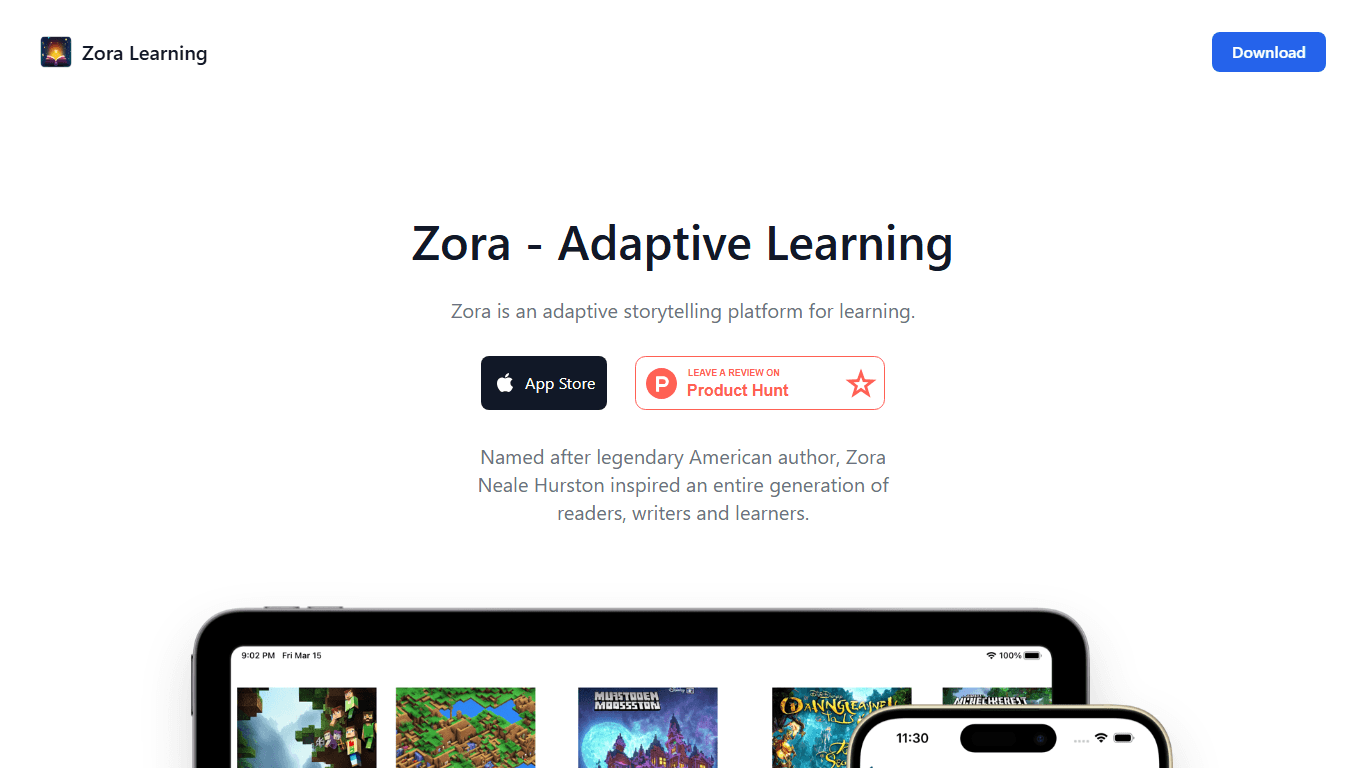
Zora Learning is a child-focused literacy app that generates adaptive stories to improve reading comprehension and vocabulary. Instead of one-size-fits-all passages, it adjusts narrative complexity to the learner. In 2026, that matters because sustained engagement is often the hardest part of reading intervention.
It stands out by combining personalization, low-friction sessions, and narrative motivation in one compact app. Editorially, it feels intentionally focused rather than bloated. External recent mention: Product Hunt reviews.
3. Key Features Under the Microscope
The core feature is adaptive storytelling with custom characters and genre selection. This creates a useful motivation loop for children who disengage when content is too easy or too hard. The product does not try to be a full curriculum engine, which helps usability but limits institutional depth.
Customization is meaningful at learner level, yet teacher-admin tooling appears lighter than mature district platforms. For families and small groups this is fine; for large deployments, it can be a constraint.
4. Hands-On Test: Output Quality and UX
Onboarding is simple and fast, with child-friendly interaction and low setup friction for parents. Session design supports frequent short practice, which is pedagogically strong for early literacy.
Output quality should be evaluated as educational quality: adaptation relevance, readability progression, and consistency over repeated sessions. On that axis, Zora Learning performs well for engagement continuity. Export-heavy workflows and formal document outputs are not central today.
Performance is generally quick in normal use. Public evidence volume is still relatively small, so claims about large-scale reliability should be validated before institutional rollout.
5. Use Cases (Who Uses It and Why?)
Classic use cases include home reading practice, literacy reinforcement after school, and guided sessions for children who resist traditional drills. Teachers and therapists can use it to keep reluctant readers active through interest-based content.
Advanced use cases include differentiated mini-sessions in mixed-level classrooms and targeted intervention blocks where adaptive narrative is used to reduce avoidance behavior.
6. Ecosystem: API, Integrations and Plugins
Zora Learning is not currently marketed as a broad enterprise integration hub. Public material emphasizes learner experience more than connector breadth.
Teams needing SIS/LMS sync, deep SSO governance, and automation workflows should confirm requirements early. For family-first usage, the lighter ecosystem is often acceptable.
7. Security, Compliance and Rights
Because the product targets children, privacy standards are a critical decision factor. The App Store listing currently indicates no data collection declared by the developer, and a privacy policy is published.
Schools and districts should still run formal checks for COPPA, local student-data rules, and GDPR-related obligations where relevant. Rights for generated stories and user artifacts should also be reviewed in current terms before scale usage.
8. Pricing Analysis
Public pricing is less explicit than in larger EdTech suites. The iOS listing shows free download entry, while long-term monetization structure is less visible in public documentation.
Value for money is strong for families seeking adaptive reading support with low activation cost. Institutional value depends on whether missing admin features force additional parallel tools.
9. Pros & Cons
- Pros: Strong engagement through adaptive, personalized storytelling.
- Pros: Parent-friendly onboarding and low session friction.
- Pros: Practical for reluctant readers and short intervention loops.
- Cons: Limited enterprise integrations and administrative depth.
- Cons: Public pricing clarity is still lighter than established competitors.
- Cons: Smaller public evidence base than legacy K-12 tools.
10. Alternatives to Zora Learning
Raz-Kids is stronger for large leveled libraries and school administration. Epic is stronger for broad reading catalog discovery. Khan Academy Kids is a compelling free alternative for families wanting wider early-learning coverage beyond reading.
Choose Zora Learning when engagement personalization is your bottleneck. Choose alternatives when institutional analytics scale or catalog breadth is the priority.
11. Detailed Scoring Grid
Accuracy & Reliability: 4.1/5. Ease of Use: 4.5/5. Features: 3.9/5. Performance & Speed: 4.2/5. Customization: 4.3/5. Security & Privacy: 4.0/5. Customer Support: 3.8/5. Value for Money: 4.2/5. Integrations: 3.3/5.
12. Conclusion
Zora Learning is a focused literacy product that can meaningfully improve reading consistency for young learners through adaptive narratives. It is strongest in family and small-group contexts where engagement is the core challenge.
Avoid it if you need district-scale administration and deep systems integration from day one. Use it aggressively if your main goal is to make children read more often with less resistance.
13. FAQ (People Also Ask)
Is Zora Learning worth it for early readers in 2026? Yes, especially for children who disengage with static passages. Adaptive story progression can maintain participation across repeated sessions. Available public ratings are positive, although still limited in count versus legacy platforms.
Is Zora Learning free or subscription-based? The current iOS listing shows free download entry. Families should still verify in-app plan details before long-term use, because pricing structures in early-stage EdTech products can evolve quickly.
How does Zora Learning compare with Raz-Kids and Epic? Zora is stronger for adaptive narrative personalization. Raz-Kids and Epic usually win on library size and institutional tooling. The better choice depends on whether your priority is engagement precision or content/admin scale.
Is Zora Learning safe for children???s data? The developer currently declares no data collection on the App Store and provides a privacy policy. Schools and parents should still review policy scope and legal obligations before sharing sensitive learner data.
Can teachers use Zora Learning in classrooms? Yes, especially for differentiated short literacy blocks and reluctant-reader intervention. For full district deployment, teams should first validate analytics, account control, and integration requirements.